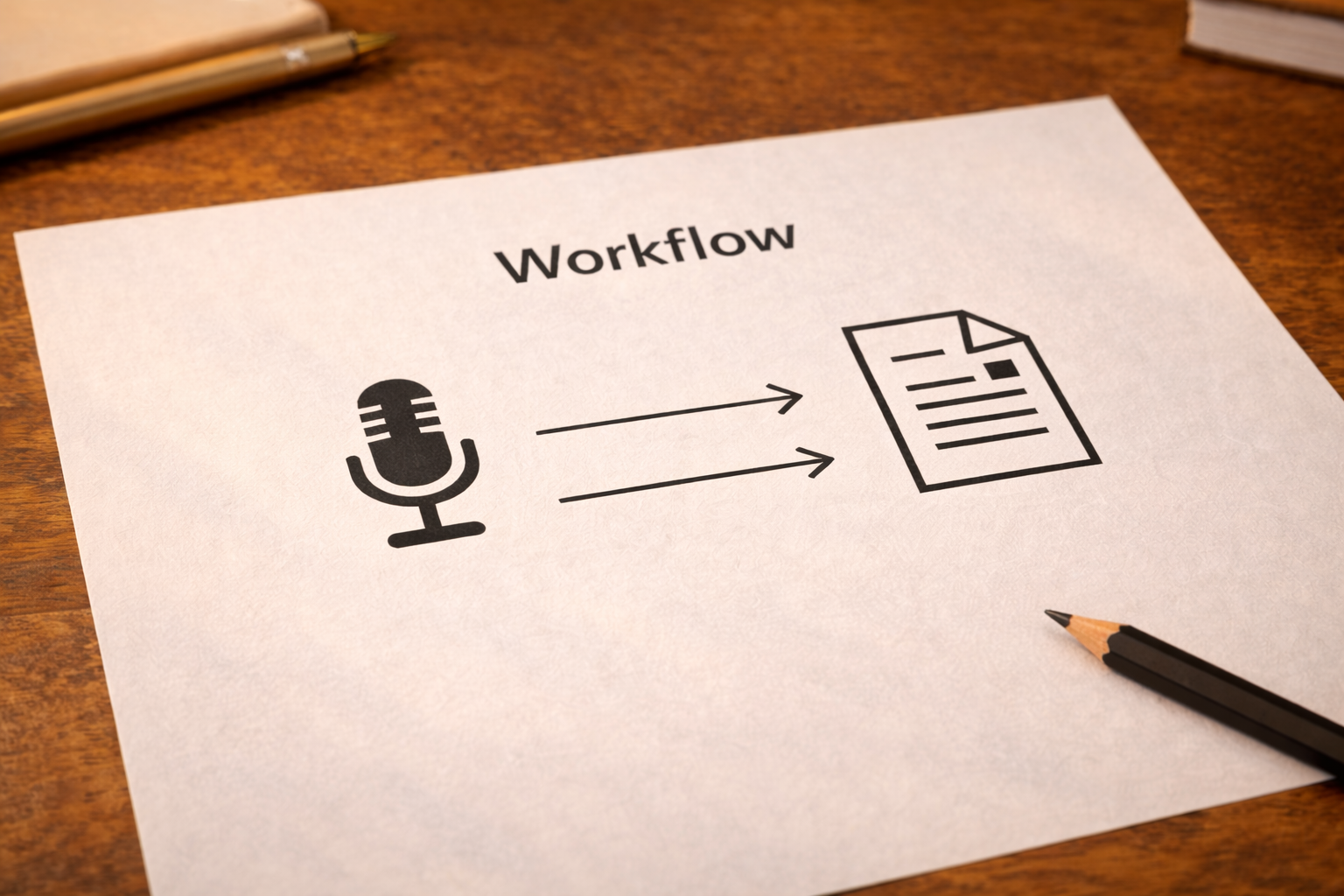
Most people try voice‑to‑text once and stop. The reason is not the tool. It is the workflow. A workflow that sticks has three parts: capture, transform, and publish.
Capture
Pick one place to record. Do not spread across apps. Consistency is the difference between a habit and a test.
Transform
Every recording should turn into a named output. That could be a note, a summary, or a script. If you do not convert it, you will not reuse it.
Publish
Share it with yourself or someone else. A note that never leaves your drafts is a missed opportunity.
The weekly loop
- Monday: record one idea
- Tuesday: clarify and summarize
- Wednesday: share or publish
Keep it small. The goal is consistency, not volume.
If your workflow has a clear end, it becomes a habit.
A stable workflow beats a perfect tool
Choose one place to record and one place to publish. Changing tools every week is the fastest way to drop the habit.
A practical rule
If it takes more than two taps to start recording, you will stop using it.
The output makes the habit
A voice note is only valuable when it becomes a usable output. Always end the workflow with a named result: note, summary, or script.
A quick system audit
If your output is not used within 48 hours, simplify the workflow. You want speed, not perfection.
A practical closing note
If you want this to work long‑term, keep the workflow small. A short, repeatable habit beats a perfect system you only use once. The output does not need to be elegant. It needs to be clear enough to move someone forward.
One last tip
End every note with a single line that starts with “Next:” and names the next action. That one line turns a note into momentum.
A final checkpoint
Before you publish, ask two questions:
- Can someone act on this without asking you to clarify?
- Is the next step obvious?
If both are true, your note is ready. Ship it and move on.
The habit is the product
A voice workflow succeeds when it ends in a usable output. Always name the output: note, summary, or script.
Keep the tools simple
If it takes more than two taps to start recording, your habit will fade. Speed is part of the workflow.
A quick audit question
If you did this workflow for 7 days, would you have 7 usable outputs? If not, simplify.
A final checkpoint
Before you publish, ask two questions:
- Can someone act on this without asking you to clarify?
- Is the next step obvious?
If both are true, your note is ready. Ship it and move on.
How to apply this in a real week
Pick one day and test the idea from “How to Build a Voice-to-Text Workflow That Actually Sticks.” Keep the output small and time‑boxed. When you finish, write down one thing you would change next time. That tiny feedback loop is what turns a nice idea into a working habit. Most workflows fail because they are too big or too vague. The smaller you keep it, the more likely you will repeat it.
A quick self‑review
After you publish, ask yourself:
- Did this feel faster than typing from scratch?
- Could someone else act on it without asking you to clarify?
- Would I repeat this tomorrow?
If the answer is yes, the workflow is working. If not, reduce the steps until it feels easy again.
A realistic expectation to set
The first time you try the workflow in “How to Build a Voice-to-Text Workflow That Actually Sticks,” it might feel awkward. That is normal. The second time is faster. By the third time, it starts to feel natural. The goal is not perfection; it is a repeatable system that saves time over a month, not a day.
A small way to make this shareable
When you finish the output, add one line that starts with “Next:” and names the next action. That one line creates momentum and makes the note valuable to someone else. This is the fastest way to turn personal notes into team‑ready updates.
A quick field test
Try this once with a real note today. Keep it short, then look at the output tomorrow. If it still makes sense 24 hours later, the structure is working. If it feels confusing, tighten the first paragraph and clarify the next step.