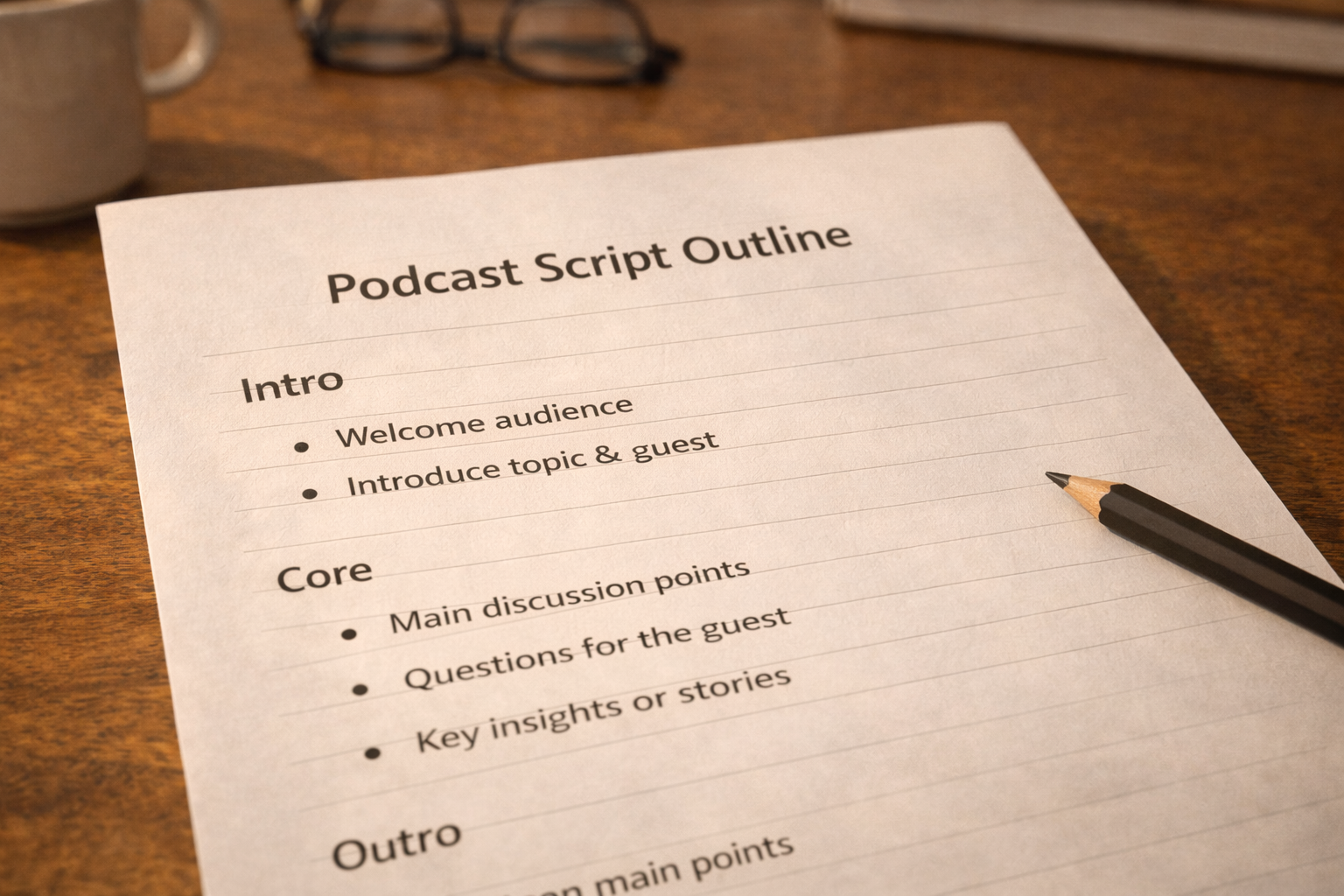
A good podcast script is not long. It is structured. If you have a transcript, you already have the raw material. The skeleton gives it shape.
Intro
Your intro has two jobs: tell people what they will learn and who it is for. Keep it under 20 seconds.
Core
The core is three points. Each point should have one example. If you have more than three, cut it.
Outro
The outro is a recap and a next action. It can be a question or a prompt to listen to the next episode.
Example skeleton
- Intro: promise + audience
- Point 1: insight + example
- Point 2: insight + example
- Point 3: insight + example
- Outro: recap + next action
Why structure matters
Structure is what separates a transcript from a show. It keeps listeners engaged and makes the message memorable.
Once you have this structure, editing is easy. You are no longer fixing a transcript. You are fitting ideas into a clear frame.
A tight episode outline
Use this short outline for most episodes:
- Hook: one line that explains the promise
- Point 1: one example and the lesson
- Point 2: one example and the lesson
- Point 3: one example and the lesson
- Wrap: recap and one next action
This format keeps you focused and makes editing much faster.
A quick audio pass
Before you publish, listen at 1.25x and mark any sentence that feels slow. Those are the first cuts.
Short episodes win
A five‑minute episode that is clear will outperform a long episode that rambles. Aim for repeatable quality, not length.
A simple title formula
Use a benefit‑first title: “How to X without Y.” It sets expectations and helps with discovery.
A final checkpoint
Before you publish, ask two questions:
- Can someone act on this without asking you to clarify?
- Is the next step obvious?
If both are true, your note is ready. Ship it and move on.
A simple timing plan
- 20 seconds: hook and promise
- 3 minutes: three points with examples
- 30 seconds: recap and next action
This pacing keeps listeners engaged and makes editing easier.
A script clean‑up pass
Read the script out loud once. Any sentence that feels heavy should be split into two. Spoken language needs air.
A headline that gets clicks
Try a benefit‑first title: “How to X without Y.” It helps listeners understand the value before they press play.
A final checkpoint
Before you publish, ask two questions:
- Can someone act on this without asking you to clarify?
- Is the next step obvious?
If both are true, your note is ready. Ship it and move on.
How to apply this in a real week
Pick one day and test the idea from “The Podcast Script Skeleton: Intro, Core, Outro.” Keep the output small and time‑boxed. When you finish, write down one thing you would change next time. That tiny feedback loop is what turns a nice idea into a working habit. Most workflows fail because they are too big or too vague. The smaller you keep it, the more likely you will repeat it.
A quick self‑review
After you publish, ask yourself:
- Did this feel faster than typing from scratch?
- Could someone else act on it without asking you to clarify?
- Would I repeat this tomorrow?
If the answer is yes, the workflow is working. If not, reduce the steps until it feels easy again.
A realistic expectation to set
The first time you try the workflow in “The Podcast Script Skeleton: Intro, Core, Outro,” it might feel awkward. That is normal. The second time is faster. By the third time, it starts to feel natural. The goal is not perfection; it is a repeatable system that saves time over a month, not a day.
A small way to make this shareable
When you finish the output, add one line that starts with “Next:” and names the next action. That one line creates momentum and makes the note valuable to someone else. This is the fastest way to turn personal notes into team‑ready updates.
A quick field test
Try this once with a real note today. Keep it short, then look at the output tomorrow. If it still makes sense 24 hours later, the structure is working. If it feels confusing, tighten the first paragraph and clarify the next step.